
Flat Roof Maintenance for Toronto Homes & Small Commercial
Flat and low-slope roofs are common on Toronto additions, garages, and small commercial buildings, and they need a different maintenance approach than a sloped shingle roof.
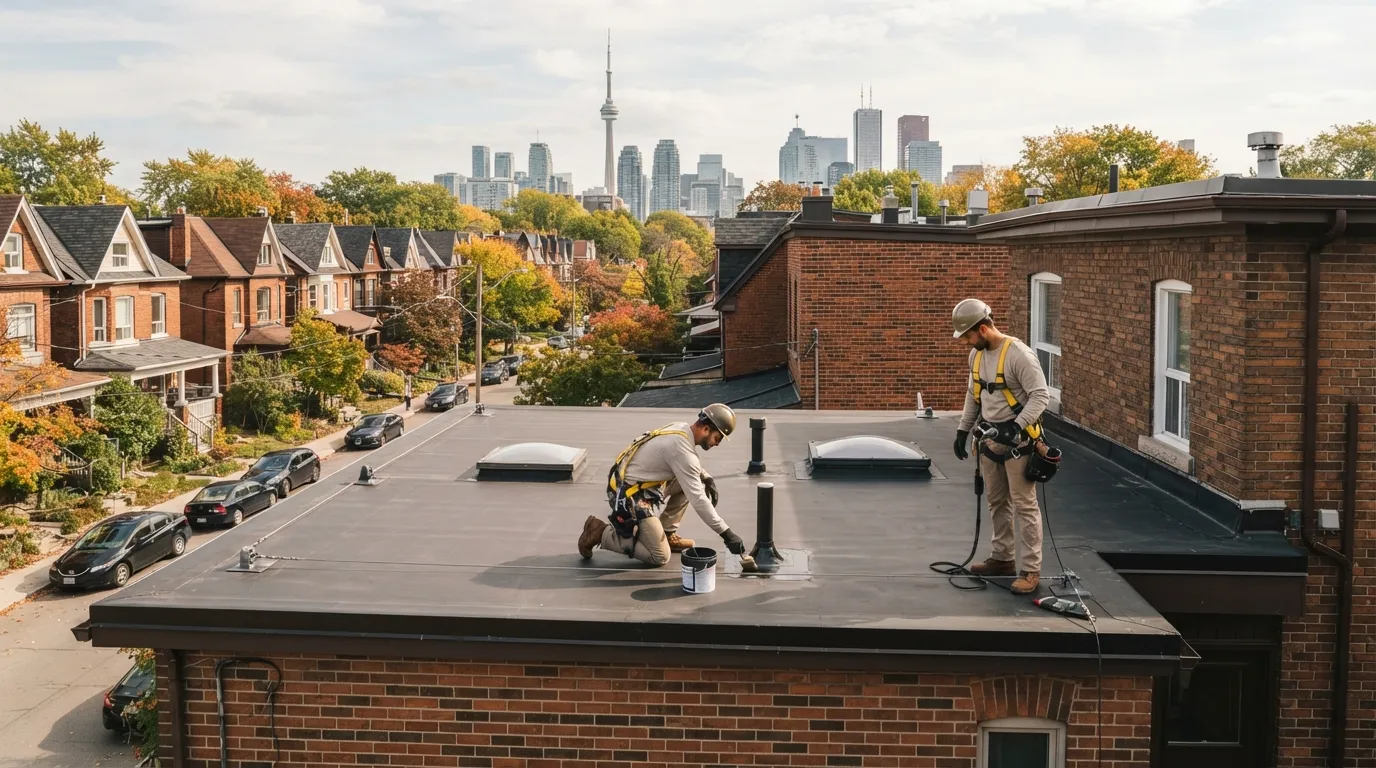
Understanding the Membrane Types
Flat roof is a slight misnomer, since a properly built low-slope roof always has some built-in slope for drainage, but the term is used broadly for any roof under roughly 2:12 pitch. What differs most between flat roofs is the membrane system, and each type has distinct maintenance needs.
Modified bitumen
A common choice on Toronto additions and older commercial buildings, modified bitumen is installed in rolled sheets, either torch-applied, self-adhered, or hot-mopped, in multiple layers (a base and cap sheet) for redundancy. It performs well in this climate but seams are the most common failure point, and granule-surfaced cap sheets can show wear patterns that indicate where the membrane is thinning.
EPDM (rubber membrane)
A single-ply synthetic rubber sheet, typically installed in large sections with fewer seams than modified bitumen, adhered or mechanically fastened. EPDM handles thermal movement and UV exposure well over a long service life, but seam tape and adhesive at penetrations and laps are the areas most likely to need attention over time.
TPO
A single-ply thermoplastic membrane, usually white or light-coloured, that is heat-welded at the seams rather than glued, which generally creates a stronger, more monolithic seam than EPDM's adhesive-based laps. TPO's reflective surface also reduces summer heat gain, which is a genuine energy-cost benefit on commercial buildings with the roof over conditioned space.
Ponding Water: Why It Matters
Standing water on a flat roof after a rain event is the single most common concern raised by homeowners and property managers, and understanding when it is a real problem versus normal behaviour is important.
Some ponding after rain is normal
A properly built low-slope roof should drain within roughly 24 to 48 hours after a rain event. Brief ponding within that window, especially on a large roof area, is generally not a concern on its own.
Ponding that persists beyond 48 hours is a problem
Water sitting for longer periods accelerates membrane degradation through prolonged UV and moisture exposure at the ponded area, adds structural dead load, and increases the chance of debris and organic buildup that can clog drains further and worsen the cycle.
Ponding location tells you something
Ponding concentrated near a drain usually points to a clogged or undersized drain. Ponding in the middle of an otherwise flat field, away from any drain, often points to structural deflection or insufficient built-in slope from the original construction, which is a more involved fix than clearing a drain.
Drainage Systems
Drainage is the single most important functional element of a flat roof, more so than on a sloped roof where gravity alone does most of the work moving water off quickly.
Interior drains and scuppers
Interior roof drains, common on commercial buildings, need clear strainers and unobstructed drain bowls. Scuppers, which are wall openings that let water exit at the roof edge, need to stay clear of debris and their downspout or conductor head needs to be functioning.
Tapered insulation systems
Many flat roofs use tapered insulation boards to create the necessary slope toward drains within an otherwise flat structural deck. Over time, if drains clog repeatedly or insulation settles unevenly, the effectiveness of the tapered system can degrade, which shows up as new or worsening ponding patterns.
Debris is a bigger issue on flat roofs than sloped ones
Leaves, seed pods, and windblown debris that would simply slide off a sloped shingle roof accumulate and sit on a flat roof, especially around drains and in roof corners. This is the single most common, and most preventable, cause of drainage problems on flat roofs in the GTA given the region's tree cover.
Seasonal Maintenance Schedule
Flat roofs benefit from a more frequent, scheduled maintenance rhythm than sloped shingle roofs, given how much drainage performance depends on keeping the surface clear.
- 1
Spring: post-winter inspection and drain clearing
Clear all drains, scuppers, and strainers of debris that accumulated over winter, and inspect the membrane surface for any cracking, blistering, or seam separation caused by winter freeze-thaw movement.
- 2
Early summer: seam and flashing check
With the membrane at a stable, warmer temperature, inspect seams, wall flashing, and penetration flashing (vents, HVAC curbs, conduit) for signs of lifting or adhesive failure, which are easier to spot and safer to address in warm weather.
- 3
Late summer or early fall: pre-leaf-drop debris clearing
A clearing pass just before major leaf drop reduces how much organic debris accumulates over fall and winter, which directly reduces drain-clogging risk through the wettest and snowiest parts of the year.
- 4
Late fall: final drain check before freeze-up
A final clearing after leaf drop is mostly complete, before sustained sub-zero temperatures set in, ensures drains are not entering winter already partially blocked, which is when a clog becomes hardest to address and most likely to cause ice buildup.
- 5
Ongoing: after any major storm
A quick visual check after any significant wind or hail event is worth doing regardless of season, since membrane roofs can suffer wind uplift at edges and corners or debris impact that is not always obvious without a direct look.
Repair vs. Restore vs. Replace: The Decision Framework
Flat roof owners eventually face a choice between three paths, and the right answer depends on the membrane's age, the extent of damage, and whether the underlying insulation and deck are still sound.
Repair: isolated, localized issues
A single failed seam, a punctured area from foot traffic or debris, or a failed pipe boot on an otherwise sound membrane is generally a repair situation. Repair makes sense when the membrane overall still has useful remaining service life and the damage is contained to a small area.
Restoration coatings: aging membrane, still structurally sound
A liquid-applied roof coating system can extend the service life of an aging but still intact membrane, particularly for reflective coating on modified bitumen or EPDM nearing the end of its rated life. This is a middle-ground option: less costly than full replacement, but only appropriate when the membrane is not actively failing or waterlogged underneath.
Replacement: widespread failure or wet insulation
If moisture has gotten under the membrane and saturated the insulation below, which can be confirmed with a moisture scan, coatings and spot repairs will not solve the underlying problem, since wet insulation stays wet and continues to degrade the deck. Widespread seam failure across the roof, rather than isolated spots, is the other clear signal that replacement is the more sensible long-term investment than continued patching.
Age is a guideline, not the deciding factor on its own
Membrane types have different typical service life ranges, and a roof at the tail end of its expected range with a good maintenance history may still have real remaining life, while a younger roof with poor drainage and repeated ponding may fail early. A physical inspection, not just the install date, should drive the decision.
Flat Roof Maintenance Questions
How often should a flat roof be professionally inspected?
Twice a year is a reasonable baseline for most Toronto flat roofs, generally spring and fall, aligned with the seasonal debris and freeze-thaw cycles the roof goes through. Small commercial buildings with more foot traffic or rooftop equipment may warrant more frequent checks.
Is standing water always a sign of a problem?
Not necessarily. Brief ponding that drains within roughly a day or two after rainfall is generally normal on a low-slope roof. Water that sits for multiple days, or that reappears in the same spot repeatedly, points to a drainage or slope issue worth investigating. Toronto Roofing Companies can check whether the cause is a clogged drain or a structural slope problem before recommending any repair.
What's the difference in lifespan between EPDM, TPO, and modified bitumen?
Each system has a different typical service life range depending on membrane thickness, installation quality, and maintenance, and manufacturer specifications vary by product line. Rather than relying on general lifespan figures, the more useful question for an existing roof is its current condition on physical inspection, since actual performance varies significantly based on maintenance history and exposure.
Can a flat roof be maintained by a homeowner without professional help?
Basic debris clearing and a visual check for obvious ponding or damage are reasonable homeowner tasks if the roof is safely accessible. Diagnosing membrane condition, seam integrity, or whether insulation underneath has gotten wet requires professional inspection and sometimes specialized equipment like a moisture scan.
Why does my flat roof pond more in one corner than everywhere else?
Localized ponding usually points to either a nearby clogged drain or a low spot from structural deflection or uneven insulation settling. A roofer can typically distinguish between the two by checking whether the ponding recedes once the nearest drain is cleared.
Is a roof coating a permanent fix or a temporary one?
A quality restoration coating, properly applied to a sound membrane, can meaningfully extend service life and is a legitimate long-term maintenance strategy, not just a stopgap. It is not appropriate, however, for a membrane with wet insulation underneath or widespread seam failure, where it would only mask a problem that continues underneath.
Do small commercial flat roofs need different maintenance than a residential one?
The core principles (drainage, seam integrity, debris control) are the same, but commercial roofs often have more rooftop equipment, more foot traffic from maintenance access, and larger membrane areas, all of which increase the number of potential failure points and generally justify a more frequent inspection schedule.
Dealing with ponding water or an aging flat roof membrane?
Toronto Roofing Companies can assess whether your flat roof needs a repair, a restoration coating, or full replacement.
Get a Free Quote