
What Drives Roof Replacement Costs in the GTA
Every roof is priced from the same underlying set of factors. Understanding them lets you compare quotes properly instead of just picking the lowest number on the page.
Roof Geometry: Pitch and Complexity
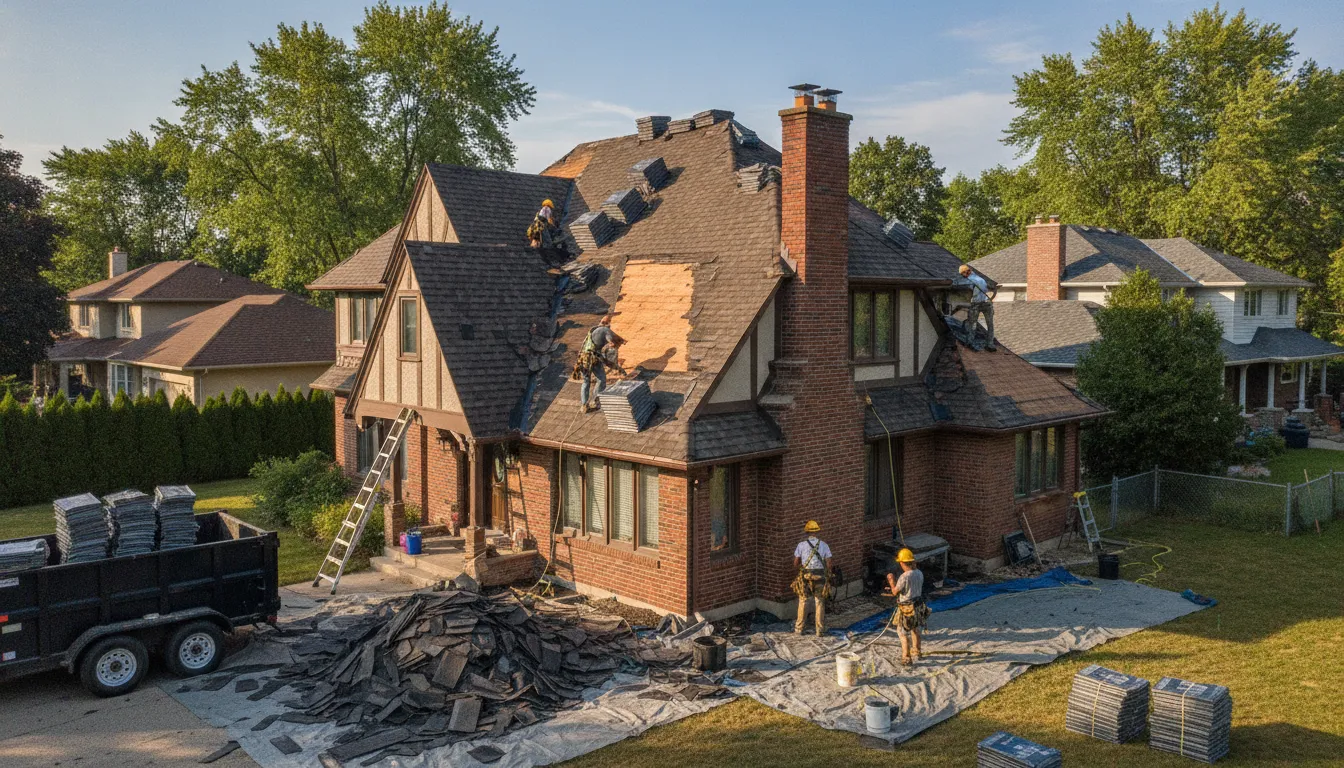
Two roofs with identical square footage can cost meaningfully different amounts to replace, and geometry is usually the reason. A simple gable roof and a roof cut up with dormers, valleys, and multiple pitch changes require very different amounts of labour, material waste, and safety equipment, even at the same total area.
Steep pitch slows everything down
Once a roof pitch climbs past roughly 6:12 to 7:12, crews generally need to work off roof jacks, staging, or fall-arrest anchor systems rather than walking the deck freely. That changes labour time per square, and it changes what safety equipment has to be on site, both of which show up in the quote.
Valleys and dormers multiply detail work
Every valley, dormer, skylight curb, and roof-to-wall transition needs custom flashing work, which is slower and more skill-intensive than running field shingles across an open plane. New-build subdivisions in Milton and Vaughan with articulated rooflines, multiple gables, and dormers built into the original design tend to price higher per square than a simple bungalow roof of the same total area.
Roof access and site constraints
A detached home with a driveway that allows a dump trailer and material lift right up to the house is faster and cheaper to service than a semi-detached or row house in older parts of Toronto with narrow lots, overhead wires, or no direct truck access. Material has to be moved by hand further, and disposal bins may need to sit on the street with permitting involved.
What's Under the Old Shingles
A quote given from a ground-level or even a rooftop visual inspection is still an estimate, because a meaningful part of the real cost only becomes clear once the old roofing material comes off. This is the single biggest source of quote-versus-final-invoice gaps in the industry, and it is worth understanding rather than being surprised by.
Layers of existing shingles
Ontario Building Code generally limits roofs to two layers of asphalt shingles before a full tear-off to the deck is required. A roof already carrying two layers costs more to strip, and stripping two layers takes meaningfully longer than one, which is reflected in most contractors' tear-off pricing tiers.
Deck condition and rot
Plywood or oriented strand board sheathing that has been exposed to chronic moisture, often near an old ice dam location, a failed valley, or a poorly flashed chimney, can be soft or delaminated. This is not visible until the shingles and underlayment come off. Reputable contractors quote a per-sheet replacement rate for deck repair as a contingency line rather than folding a guess into the base price.
This is exactly why 1950s-1970s housing needs a wider contingency buffer
Older Scarborough and Etobicoke homes have had more decades of freeze-thaw cycling, more chances for a slow flashing leak to go unnoticed, and in some cases original wood plank decking instead of plywood sheathing, which changes fastening approach and cost. Budgeting a contingency allowance up front, rather than treating any deck repair cost as a surprise, is the realistic way to plan for these homes.
Material Tier
Material cost is the most visible line item to homeowners, and it is also the widest range in most quotes because the differences between shingle tiers are real, not just marketing.
3-tab asphalt shingles
The lowest-cost tier, with a flat, single-layer appearance and generally the shortest wind and impact ratings. Increasingly hard to find as a first-quality product from major manufacturers, since most of the market has shifted toward architectural shingles even at the budget end.
Architectural (laminated) shingles
The current mainstream standard for GTA residential re-roofing. A layered construction gives a dimensional look and generally better wind resistance than 3-tab. Most quotes in this market are built around a mid-tier architectural product as the default recommendation.
Premium and designer shingle lines
Heavier, thicker laminated products with enhanced algae resistance, higher wind and impact ratings, and styling that mimics slate or wood shake. These cost more per square and are a reasonable upgrade for homeowners planning to stay long-term or in neighbourhoods where the aesthetic matters to resale.
Underlayment and accessory materials matter too
Synthetic underlayment versus older felt paper, the width and coverage of ice and water shield at eaves and valleys, starter strip quality, and ridge cap product all add up. A quote that looks cheap on the shingle line sometimes cuts corners on these secondary materials instead.
Disposal, Permits, and Timing
Beyond labour and material, several logistics-driven costs vary by project and by season, and they are easy for a homeowner to overlook when comparing two quotes side by side.
Disposal bin size and tipping fees
Torn-off shingles are heavy. A steep, multi-layer, large-area roof generates significantly more disposal weight than a simple single-layer bungalow roof, and tipping fees at waste facilities are typically charged by weight. This is a real cost driver that scales with the same factors as the labour itself.
Permits for larger or structural work
A straightforward like-for-like shingle replacement generally does not require a building permit in most GTA municipalities, but work that touches structural elements, adds skylights, or changes roof framing typically does. Permit and inspection costs and timelines vary by municipality, so confirm what applies to your specific project and city before assuming either way.
Seasonal timing affects both price and availability
Late spring through fall is peak season for GTA roofing, when demand and scheduling pressure are both highest. Shoulder-season work in late fall or even winter is possible, since shingle manufacturers rate their products for cold-weather installation down to certain temperature thresholds with adjusted technique, but availability and sometimes pricing shift with the season. Booking early in the year for a fall install is a reasonable way to get better scheduling flexibility.
How to Compare Quotes Properly
The lowest number on a page is meaningless without knowing what it includes. Use this sequence to line up quotes on an apples-to-apples basis before deciding.
- 1
Confirm the quote is for a full tear-off, not an overlay
Ask directly whether the price assumes stripping to the deck or laying new shingles over the old layer. These are very different scopes and the price difference should reflect that, not obscure it.
- 2
Ask for the exact shingle product name and line
'Architectural shingles' is not specific enough. Get the manufacturer and product line so you can look up its wind rating, impact rating, and warranty terms yourself rather than relying on a verbal description.
- 3
Check what underlayment and ice and water shield coverage is included
Ask specifically how far up the eaves the ice and water shield extends and whether valleys and skylight curbs are included in that coverage, since this varies between quotes even when the shingle product is identical.
- 4
Get the deck repair contingency rate in writing
Ask what the per-sheet rate is for replacing damaged decking if it is found during tear-off, and roughly how many sheets a contractor would expect to see as a worst-case on a home your age and condition.
- 5
Confirm what happens to ventilation and flashing
A quote should specify whether existing vents, flashing, and pipe boots are being reused or replaced. Reusing old flashing on a new roof is a common corner-cutting move that saves the contractor money at the expense of the roof's long-term watertightness.
- 6
Ask about cleanup, magnetic nail sweep, and disposal
A full tear-off scatters roofing nails across the property and landscaping. Confirm the quote includes a magnetic sweep of the yard and driveway, and that disposal bin costs are included rather than billed separately after the fact.
- 7
Compare warranty terms, not just warranty length
A 25-year or lifetime shingle warranty from the manufacturer typically only covers material defects at full value for a limited initial period, then prorates. Separately, ask what workmanship warranty the contractor itself provides, since that is a different and often shorter guarantee covering installation quality.
Red Flags in a Quote or Sales Process
Some warning signs show up before a single shingle is installed. These are worth screening for regardless of price.
Pressure to sign same-day
A legitimate contractor can hold a quoted price for a reasonable review period. Heavy pressure to sign immediately, especially after a storm, is a common tactic worth being wary of.
A quote with no line-item breakdown
A single lump-sum number with no detail on material, layers of tear-off, or scope makes it impossible to compare against another quote or to know what you are actually paying for.
Unusually large upfront deposit demands
Some deposit to secure materials and scheduling is normal. A demand for the majority of the total cost before any work begins is a pattern worth questioning.
No mention of permits when the scope clearly needs one
If the project involves structural changes, added skylights, or a full re-roof on certain property types, and permits are never mentioned, ask directly rather than assuming it was handled.
Vague or missing insurance and WSIB coverage details
A contractor should be able to provide proof of liability insurance and WSIB clearance readily. Reluctance or vagueness here is a legitimate concern, since uninsured work exposes the homeowner if something goes wrong.
Roof Replacement Cost Questions
Why did my neighbour's similar-looking roof cost less than my quote?
Even visually similar roofs can differ in pitch, number of shingle layers underneath, deck condition, and access. A quote that seems higher may reflect a harder tear-off or worse deck condition discovered or anticipated on your specific home, not just a difference in contractor pricing.
Is it cheaper to install shingles over the old layer instead of a full tear-off?
An overlay is generally less expensive up front since it skips tear-off labour and disposal cost, but it is limited to one existing layer under Ontario Building Code, hides the deck condition rather than addressing it, and typically shortens the effective lifespan of the new shingles because they are not laying flat against a solid, inspected deck.
Does roof replacement cost more in winter?
Availability and scheduling pressure typically ease in the off-season, which can work in a homeowner's favour, but cold-weather installation requires adjusted technique for shingle sealing and sometimes different handling to avoid cracking. Ask your contractor how they handle cold-weather installation rather than assuming winter pricing is automatically cheaper.
How much of the cost difference between quotes is just markup?
Some, but usually less than homeowners assume. Real cost drivers like tear-off layers, deck condition, access, material tier, and disposal weight typically explain most of the spread between quotes. This is why getting the scope details in writing matters more than comparing bottom-line totals.
Should I get more than one quote?
Yes, generally two to three quotes is a reasonable range. It gives you enough data to spot outliers in either direction without dragging the process out. Toronto Roofing Companies can walk through your specific roof's cost drivers so you know what to expect before comparing quotes from other contractors.
Do permits add much to the total cost?
For a standard like-for-like shingle replacement, permits are often not required in the first place. When they are required, for structural work or added roof penetrations, the permit fee itself is typically a small fraction of total project cost, though it can add time to the schedule for inspection sign-off.
Want a cost breakdown specific to your roof?
Toronto Roofing Companies provides itemized quotes so you know exactly what you're paying for and why, before you compare against anyone else.
Get a Free Quote